
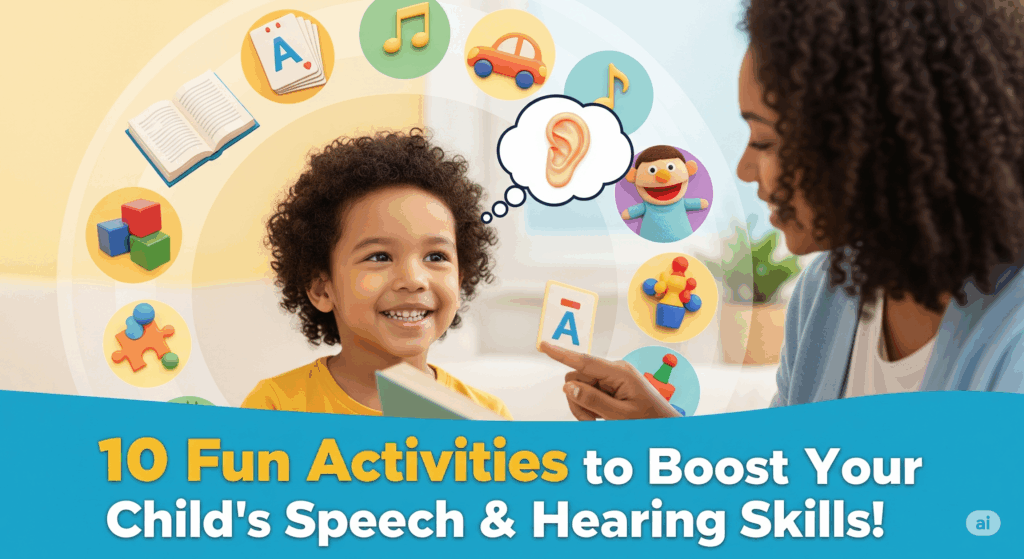
As parents, fostering strong speech and hearing skills in your child is crucial for their communication, social development, and academic success. Engaging in fun, interactive activities can significantly enhance their language abilities while making learning enjoyable.
In this blog, we’ll explore ten effective activities to boost your child’s speech and hearing development, along with expert tips to maximize their progress.
Why Are Speech and Hearing Skills Important?
Before diving into the activities, let’s understand why these skills matter:
- Speech Development: Helps children articulate words clearly, form sentences, and express thoughts.
- Hearing Skills: Essential for understanding language, following instructions, and engaging in conversations.
- Social & Academic Success: Strong communication skills improve confidence, learning, and peer interactions.
Now, let’s explore ten engaging activities to support your child’s growth!
1. Reading Aloud Together
How it Helps: Enhances vocabulary, listening skills, and comprehension.
How to Do It:
- Choose colorful, age-appropriate books.
- Use expressive tones and ask questions (e.g., “What do you think happens next?”).
- Encourage your child to repeat words or describe pictures.
Pro Tip: Make reading a daily habit—even 10 minutes a day makes a difference!
2. Singing Nursery Rhymes & Songs
How it Helps: Improves rhythm, pronunciation, and memory.
How to Do It:
- Sing simple songs like “Twinkle Twinkle Little Star” or “Old MacDonald.”
- Use hand motions to make it interactive.
- Pause occasionally to let your child fill in the words.
Pro Tip: Repetition is key—children learn best through familiar tunes.
3. Playing Sound Identification Games
How it Helps: Sharpens auditory discrimination (recognizing different sounds).
How to Do It:
- Use household items (e.g., shaking keys, ringing a bell).
- Ask, “What’s that sound?”
- Play animal sound games (e.g., “What does a cow say?”).
Pro Tip: Gradually introduce more complex sounds as they improve.
4. Engaging in Pretend Play
How it Helps: Encourages conversation, imagination, and sentence formation.
How to Do It:
- Set up a pretend kitchen, doctor’s office, or school.
- Take on roles and encourage dialogue (e.g., “What should we cook today?”).
- Introduce new vocabulary related to the play scenario.
Pro Tip: Follow your child’s lead to keep them interested.
5. Using Flashcards with Pictures & Words
How it Helps: Builds vocabulary and word association.
How to Do It:
- Show a flashcard (e.g., an apple) and say the word clearly.
- Ask your child to repeat it.
- Expand with phrases (e.g., “Red apple” or “I eat an apple.”).
Pro Tip: Start with common objects before moving to abstract concepts.
6. Practicing Simple Speech Exercises
How it Helps: Strengthens mouth muscles for clearer speech.
How to Do It:
- Blowing bubbles (improves breath control).
- Making funny faces (exercises facial muscles).
- Repeating tongue twisters (e.g., “She sells seashells”).
Pro Tip: Keep sessions short and fun to avoid frustration.
7. Encouraging Storytelling
How it Helps: Boosts creativity, sentence structure, and sequencing.
How to Do It:
- Ask your child to narrate their day.
- Use picture prompts to create stories together.
- Praise their efforts, even if sentences are short.
Pro Tip: Ask open-ended questions to expand their responses.
8. Playing “I Spy” with Sounds
How it Helps: Enhances listening and phonemic awareness.
How to Do It:
- Say, “I spy something that starts with ‘b’.”
- Let them guess (e.g., ball, book).
- Switch roles and let them give clues.
Pro Tip: Focus on beginning, middle, and ending sounds as they progress.
9. Incorporating Technology Wisely
How it Helps: Interactive apps can reinforce learning.
How to Do It:
- Use educational apps like Speech Blubs or Endless Alphabet.
- Set time limits and engage with your child (don’t rely solely on screens).
Pro Tip: Choose apps with speech recognition for feedback.
10. Modeling Correct Speech
How it Helps: Children learn by imitation.
How to Do It:
- Speak clearly and at a moderate pace.
- Avoid baby talk—use proper words.
- Gently correct mistakes by repeating the right pronunciation.
Pro Tip: Be patient—progress takes time!
When to Seek Professional Help
If your child shows signs of speech delay (e.g., limited words by age 2, unclear speech, not responding to sounds), consult a speech-language pathologist (SLP) or audiologist for an evaluation.
Final Thoughts
Promoting speech and hearing skills doesn’t have to be stressful—consistency and fun are key! By integrating these activities into daily routines, you’ll help your child build strong communication foundations.
Which activity will you try first? Let us know in the comments!