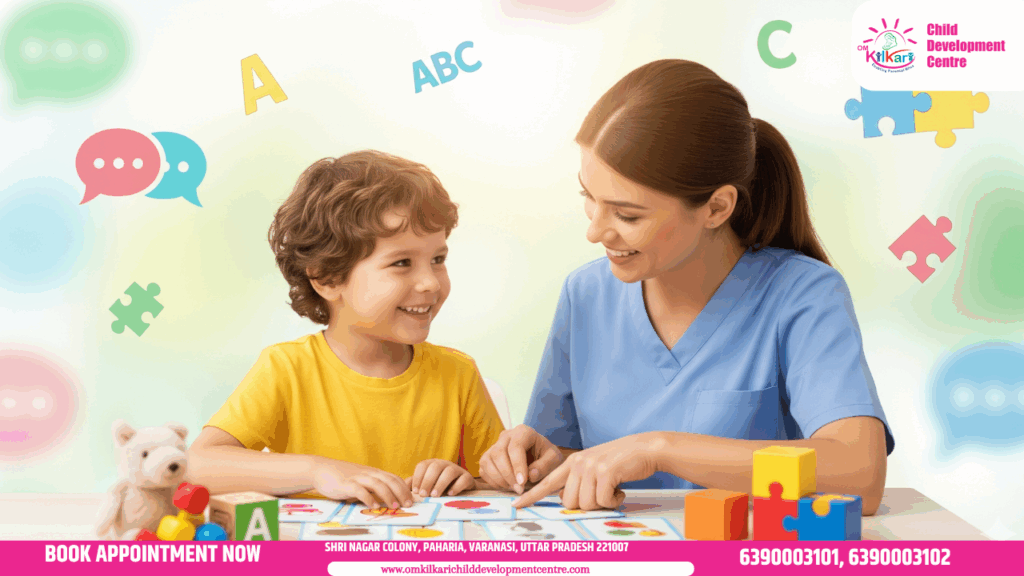
Every parent looks forward to hearing their child’s first words. That small milestone becomes the foundation of communication, social bonding, and emotional connection. However, for some children, speech development does not progress as smoothly as expected. Struggling to form sounds, finding it difficult to express thoughts, or being unable to communicate clearly can all indicate a speech disorder.
Speech disorders in children are more common than many realise. According to research, approximately 5–8% of preschool children experience speech and language difficulties. While many overcome these challenges with time, others require early intervention and professional support.
In this comprehensive guide, we’ll explore everything parents, educators, and caregivers need to know about speech disorders in children:
- What they are
- Their causes and types
- Early signs to look out for
- Diagnosis methods
- Treatment options
- How parents can support their child at home
What Are Speech Disorders?
Speech disorders are conditions that affect a child’s ability to produce sounds correctly or fluently. They may struggle with articulation (pronouncing sounds), fluency (smoothness of speech), or voice quality (pitch, volume, or resonance).
It is important to differentiate between speech disorders and language disorders:
- Speech disorder: Affects how a child produces speech sounds (clarity, fluency, and voice).
- Language disorder: Involves difficulties in understanding, processing, or using words to communicate.
Many children with speech disorders also experience language difficulties, but the two are not always linked.
Types of Speech Disorders in Children
Speech disorders in children can be classified into several categories. Understanding these types is the first step toward early recognition and support.
1. Articulation Disorders
Articulation refers to the physical production of sounds. Children with articulation disorders may:
- Substitute sounds (saying “wabbit” for “rabbit”)
- Omit sounds (saying “nana” for “banana”)
- Distort sounds (slurred or unclear pronunciation)
This is one of the most common speech issues in preschool children.
2. Phonological Disorders
Unlike articulation errors, phonological disorders involve patterns of sound errors. A child may apply a rule incorrectly across words (e.g., always substituting “t” for “k”).
3. Fluency Disorders (Stuttering)
Fluency disorders disrupt the natural flow of speech. Common signs include:
- Repetition of sounds or syllables (e.g., “b-b-ball”)
- Prolonging sounds (e.g., “ssssun”)
- Blocks or pauses during speech
Stuttering often starts between the ages of 2 and 6.
4. Voice Disorders
A child with a voice disorder may have:
- Hoarseness
- Breathiness
- Pitch too high or too low
- Strained or weak voice
This could result from vocal misuse, nodules on the vocal cords, or medical conditions.
5. Childhood Apraxia of Speech (CAS)
CAS is a motor speech disorder where the brain struggles to coordinate the movements needed to speak, even though the muscles are not weak. Children with CAS may:
- Struggle to say longer words
- Be inconsistent in speech errors
- Have difficulty imitating sounds
6. Dysarthria
This condition occurs when weak muscles (due to neurological problems such as cerebral palsy or muscular dystrophy) affect speech clarity.
Causes of Speech Disorders in Children
Speech disorders may result from multiple factors, including:
- Developmental delays
- Hearing loss (temporary due to ear infections or permanent)
- Neurological conditions (cerebral palsy, brain injury, autism spectrum disorder)
- Genetic conditions (Down syndrome, cleft palate)
- Environmental factors (limited exposure to language, trauma, neglect)
- Bilingual or multilingual environment (not a disorder itself, but can sometimes delay clear articulation)
In many cases, the exact cause is unknown, but early intervention still significantly improves outcomes.
Early Signs of Speech Disorders
Parents and teachers play a critical role in identifying speech disorders early. Here are developmental red flags to watch for:
- By 12 months: Not babbling or responding to sounds
- By 18 months: Limited vocabulary, difficulty imitating sounds
- By 2 years: Using fewer than 50 words, hard to understand even by parents
- By 3 years: Speech unclear to unfamiliar people, difficulty forming sentences
- By 4 years: Frequent sound errors, stuttering, or frustration when speaking
If a child consistently lags behind these milestones, an evaluation by a speech-language pathologist (SLP) is recommended.
Diagnosis: How Are Speech Disorders Identified?
Speech disorders are diagnosed through a comprehensive evaluation by an SLP. The process typically includes:
- Case History – Collecting developmental, medical, and family history.
- Hearing Assessment – To rule out hearing loss.
- Oral-Motor Exam – Checking muscles used for speech.
- Standardised Speech Tests – Measuring articulation, fluency, and voice quality.
- Language Assessment – Evaluating comprehension and expression.
- Parent/Teacher Interviews – Understanding how speech impacts daily life.
Early diagnosis allows for individualised therapy, which can prevent long-term communication and academic difficulties.
Treatment Options for Speech Disorders
Treatment varies depending on the type and severity of the disorder. Key approaches include:
1. Speech Therapy
The cornerstone of treatment. Techniques may include:
- Articulation drills
- Sound modelling and repetition
- Language games and storytelling
- Breathing exercises for fluency
2. Parent Involvement
Therapists often train parents to continue speech exercises at home. Daily practice accelerates progress.
3. Assistive Technology
For severe cases, augmentative and alternative communication (AAC) devices, such as speech-generating apps, may be used.
4. Medical/Surgical Interventions
For disorders linked to cleft palate, hearing loss, or vocal cord issues, medical treatment may be required alongside therapy.
5. Group Therapy & Social Interaction
Practising in group settings helps children gain confidence and generalise speech skills.
How Parents Can Support a Child with a Speech Disorder at Home
Parents are the biggest support system for children with speech challenges. Practical strategies include:
- Talk often: Narrate daily activities to model language.
- Read together: Storybooks improve vocabulary and sentence structure.
- Encourage play: Games that involve communication (role play, board games).
- Be patient: Avoid finishing sentences for the child.
- Create a supportive environment: Praise efforts rather than focusing only on accuracy.
- Limit screen time: Interactive conversation is far more valuable than passive listening.
Impact of Speech Disorders on Children’s Development
If left unaddressed, speech disorders can affect multiple aspects of life:
- Academic performance – Difficulty reading, spelling, and writing
- Social skills – Struggles with making friends and expressing feelings
- Emotional well-being – Frustration, low self-esteem, or withdrawal
- Future opportunities – Communication skills are vital for personal and professional success
This is why early recognition and therapy are crucial.
Success Stories: Hope for Families
Many children with speech disorders achieve remarkable progress with timely intervention. For instance:
- A 4-year-old with severe stuttering, after 1 year of therapy, could confidently recite rhymes in front of peers.
- A child with apraxia, through consistent therapy and parental support, began forming full sentences by age 6.
These success stories highlight the importance of persistence, professional guidance, and family involvement.
FAQs on Speech Disorders in Children
1. Can speech disorders go away on their own?
Mild articulation issues may resolve naturally, but most speech disorders need professional therapy.
2. How long does speech therapy take?
It varies. Some children improve in months, while others require years of support.
3. Can bilingualism cause speech disorders?
No. Learning multiple languages might cause temporary mixing, but it does not cause a disorder.
4. Is stuttering curable?
There’s no absolute cure, but therapy significantly improves fluency and confidence.
5. When should I worry about my child’s speech?
If your child is not meeting speech milestones or struggles to communicate clearly by age 3, consult a speech therapist.
Conclusion
Speech is not just about words—it’s about connection, learning, and self-expression. When a child faces speech challenges, it affects their confidence, relationships, and future opportunities. But with early identification, professional therapy, and strong parental support, children with speech disorders can thrive.
Parents should never ignore early signs or wait for a child to “grow out of it.” The sooner the intervention, the better the outcome. Together—with speech therapists, educators, and family—every child can be given the voice they deserve.