At OM Kilkari Child Development Centre, we believe in nurturing every child’s potential—emotionally, cognitively, and behaviorally. One of the most evidence-based and transformative approaches we use in our therapies is Cognitive Behavioral Therapy (CBT). This definitive guide provides parents, educators, and caregivers a comprehensive understanding of CBT, its benefits for children, and how it is tailored to enhance childhood development at our centre in Varanasi.
What is Cognitive Behavioral Therapy (CBT)?
CBT is a structured, goal-oriented form of psychotherapy that helps individuals understand the connection between their thoughts, feelings, and behaviors. Originally developed to treat depression, CBT has evolved into a powerful tool used for various psychological challenges in children including:
- Anxiety disorders
- ADHD
- Autism Spectrum Disorders (ASD)
- Learning disabilities
- Oppositional Defiant Disorder (ODD)
- Depression
- Phobias
- Behavioral outbursts
The core idea is: Change the way you think, and you’ll change the way you feel and behave.
How CBT Works: The ABC Model
CBT follows a cognitive model called the ABC Model:
- A – Activating Event (What happened?)
- B – Beliefs (What does the child believe about it?)
- C – Consequences (Emotional & behavioral response)
At OM Kilkari, our therapists help children examine their beliefs and replace unhelpful patterns with healthier thought processes and coping mechanisms.
Why CBT Matters for Children
Childhood is a critical period of cognitive and emotional growth. Unfortunately, children may face difficulties expressing their emotions, dealing with trauma, or handling peer pressure. CBT helps them:
- Understand and manage their emotions
- Improve attention and concentration
- Develop positive self-talk
- Replace irrational fears with logic
- Build resilience and social confidence
At OM Kilkari, we see CBT as a life skill, not just therapy.
CBT for Children vs. Adults: What’s Different?
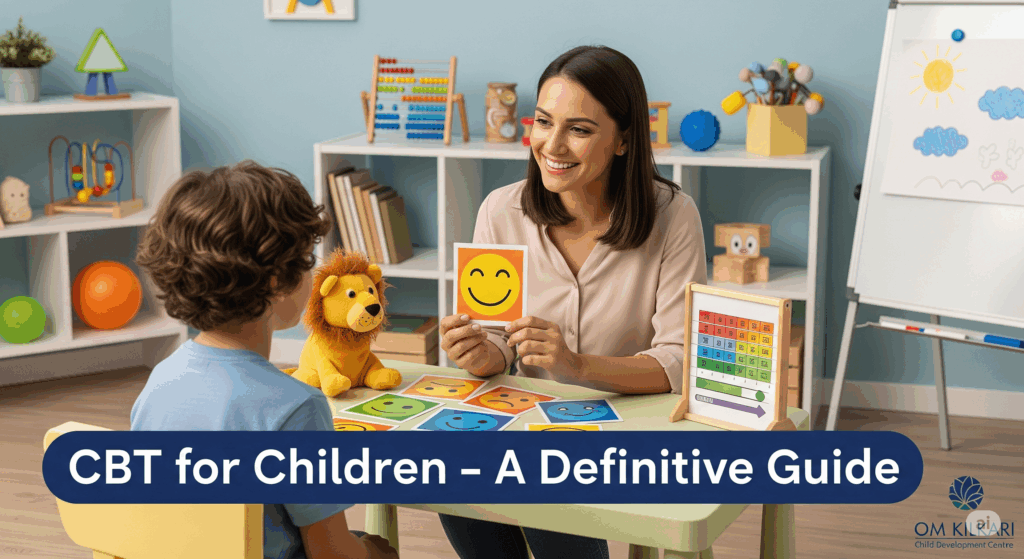
While CBT in adults involves self-reflection and dialogue, child-focused CBT at OM Kilkari is age-appropriate, interactive, and play-based. We use:
- Role-playing and puppet therapy
- Storytelling and worksheets
- Therapeutic games
- Visual prompts like emotion cards
- Mindfulness and relaxation exercises
The goal is the same: empower the child to be their own problem-solver.
Who Can Benefit from CBT at OM Kilkari?
We use CBT to support children facing:
1. Anxiety Disorders
Children may suffer from separation anxiety, phobias, or social anxiety. CBT helps them identify irrational fears and replace them with rational coping strategies.
2. Autism Spectrum Disorder (ASD)
Children with ASD often struggle with emotional regulation and social interaction. CBT improves:
- Emotional labeling
- Flexibility in thinking
- Handling transitions
3. Attention Deficit Hyperactivity Disorder (ADHD)
CBT complements occupational and behavioral therapies by helping children:
- Reduce impulsive thinking
- Increase attention span
- Improve task completion
4. Depression and Low Self-Esteem
Through CBT, children learn to challenge negative beliefs like “I am not good enough” and replace them with affirming thoughts.
5. Oppositional Behaviors
For children displaying defiance or aggression, CBT helps build empathy, impulse control, and respect for boundaries.
How We Implement CBT at OM Kilkari
1. Initial Assessment
Every child is unique. Our team begins with a holistic evaluation including:
- Behavioral observation
- Parental interviews
- Cognitive and emotional screening
2. Individualized Therapy Plan
CBT plans are tailored to the child’s needs. Plans may include:
- Weekly 1-on-1 CBT sessions
- Parental involvement strategies
- Progress tracking and reports
3. Integration with Other Therapies
At OM Kilkari, CBT is often integrated with:
- Speech therapy
- Occupational therapy
- Special education
- Sensory integration therapy
4. Parent and Teacher Training
We equip parents and teachers with CBT-based strategies they can reinforce at home or in school:
- Reward systems
- Emotional vocabulary building
- Behavior charts
- Problem-solving steps
Key CBT Techniques Used with Children
1. Thought Journals
Children write or draw their daily experiences, helping them understand their emotions and triggers.
2. Cognitive Restructuring
We guide the child in spotting irrational or harmful thoughts and replacing them with helpful ones.
Example:
- Negative thought: “Everyone hates me.”
- Reframed thought: “Some kids may be upset, but others still like me.”
3. Relaxation Techniques
- Deep breathing
- Progressive muscle relaxation
- Guided imagery
These tools help children calm down when anxious or upset.
4. Exposure Therapy
Gently confronting fears in a safe, gradual way:
- Afraid of school? Start with drawing it.
- Then, walking past it.
- Finally, attending with support.
5. Social Skills Training
Practicing:
- Eye contact
- Taking turns
- Starting conversations
- Conflict resolution
Success Stories at OM Kilkari
Case 1: Ria (Age 9) – Overcoming Social Anxiety
Ria, a bright child, feared going to school due to bullying. Through CBT, she learned to:
- Reframe thoughts about bullies
- Build self-confidence
- Use calming techniques
Today, she’s active in group discussions and even mentors others.
Case 2: Aarav (Age 7) – Managing Anger Issues
Aarav frequently had outbursts and classroom disruptions. CBT helped him:
- Understand his triggers
- Use anger scales and coping cards
- Talk it out before reacting
Now, he enjoys learning and socializing with peers.
Why Choose OM Kilkari for CBT?
✅ Experienced Clinical Team
Our certified child psychologists and therapists are trained in evidence-based CBT approaches.
✅ Child-Centered Environment
We use child-friendly therapy rooms with sensory tools, toys, and calming colors to make therapy enjoyable.
✅ Holistic Child Development
We address emotional, cognitive, behavioral, sensory, and communication needs in one place.
✅ Parental Guidance & Counseling
We involve parents at every step through:
- Feedback sessions
- Home behavior programs
- Emotional coaching
✅ Therapy + Education
If required, CBT is integrated into our inclusive education programs for children with special needs.
How Parents Can Support CBT at Home
- Encourage children to express emotions
- Avoid labeling: “bad child” → use “inappropriate behavior”
- Be consistent with consequences and rewards
- Practice mindfulness together
- Model healthy self-talk
- Celebrate small victories
Remember, parents are partners in therapy.
CBT Misconceptions & Clarifications
| Misconception | Truth |
|---|---|
| CBT is only for mental illness | It builds emotional skills in all children |
| It’s just talk therapy | It includes play, activities, and worksheets |
| Only psychologists can use CBT | Trained teachers and parents can apply basic techniques |
| CBT is a one-time fix | It’s a continuous, skill-building journey |
The Future of CBT in Child Development
As childhood mental health receives more attention globally, CBT is evolving. Emerging areas include:
- Digital CBT games & apps
- Virtual reality for phobias
- CBT for trauma-informed care
- Parent-Child Interaction Therapy (PCIT)
- Group CBT for peer learning
At OM Kilkari, we continue to integrate the latest CBT models backed by science and compassion.
Conclusion
Cognitive Behavioral Therapy is more than a treatment—it’s a powerful developmental tool that helps children thrive. At OM Kilkari Child Development Centre, we’re proud to offer customized CBT programs that empower young minds to overcome challenges and embrace growth.