Introduction: Understanding ADHD in Children
Every child’s developmental journey is unique. While some children meet milestones smoothly, others face hurdles that require additional support. One of the most common developmental conditions today is ADHD (Attention-Deficit/Hyperactivity Disorder).
Children with ADHD may experience such as:
- Difficulty paying attention
- High distractibility
- Impulsive behavior
- Struggles with emotional regulation
- Limited social interaction skills
At OM Kilkari Child Development Centre, we specialize in creating structured, supportive, and engaging group therapy sessions for children with ADHD. Led by certified Occupational Therapists, our approach goes beyond academics to focus on behavior, social skills, sensory integration, and emotional well-being.
What is ADHD?
ADHD is a neurodevelopmental disorder affecting a child’s ability to focus, regulate behavior, and manage impulses. It is not simply “being naughty” or “too energetic”—it is a medical condition recognized worldwide.
Key Symptoms of ADHD
| Symptom Type | Examples in Daily Life |
|---|---|
| Inattention | Forgetting schoolwork, losing belongings, not listening to instructions |
| Hyperactivity | Excessive talking, fidgeting, difficulty staying seated |
| Impulsivity | Interrupting others, blurting out answers, trouble waiting turns |
ADHD Beyond Academics
While ADHD often shows up in school performance, it deeply affects friendships, family interactions, and emotional growth. This is why therapy must look beyond academics and focus on the whole child.
Occupational Therapy for ADHD: A Holistic Approach
Occupational Therapy (OT) is often misunderstood as only helping children with physical tasks. In reality, OT addresses a wide spectrum of developmental needs.
How OT Helps Children with ADHD
- Behavioral Support: Teaching coping strategies to manage impulsivity.
- Sensory Integration: Helping children process sensory input like sound, touch, and movement.
- Emotional Regulation: Providing tools to manage frustration, anger, or sadness.
- Social Skills Training: Building confidence in group interactions.
- Functional Skills: Developing routines for school, homework, and play.
At OM Kilkari, our therapists customize therapy for each child, ensuring that strengths are celebrated and weaknesses are addressed compassionately.
Why Group Therapy is Effective for ADHD
While individual therapy helps, group therapy offers something unique—context.
Children with ADHD often struggle when interacting with others. Group therapy allows them to practice real-world social skills in a safe, structured, and guided environment.
Benefits of Group Therapy
- Peer Learning – Children observe and learn from peers.
- Socialization – Practice turn-taking, sharing, and teamwork.
- Real-Time Feedback – Therapists guide children in the moment.
- Confidence Building – Children realize they are not alone.
- Fun Engagement – Games, activities, and role play make learning enjoyable.
Inside a Typical ADHD Group Therapy Session at OM Kilkari
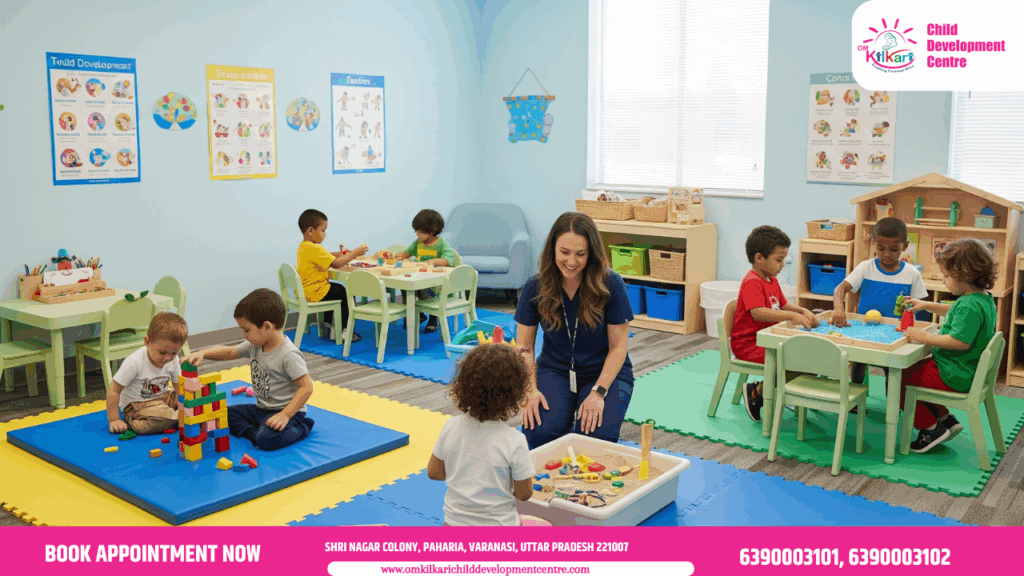
Our therapy rooms are colorful, warm, and child-friendly—nothing like the cold, clinical spaces you may imagine.
Structure of a Session
- Warm-Up Circle – Children share a recent achievement or challenge.
- Sensory-Motor Activities – Obstacle courses, balance games, or movement-based activities to channel energy.
- Collaborative Group Task – Building towers, art projects, or problem-solving games to improve cooperation.
- Skill Building – Social skills role play, emotion recognition cards, or listening games.
- Mindfulness & Relaxation – Deep breathing, guided imagery, or calming activities before ending.
This balanced flow of active, social, and calming activities helps children regulate energy while practicing essential life skills.
The Role of Family in ADHD Therapy
Therapy does not end in the clinic—it must continue at home. At OM Kilkari Child Development Centre, we involve parents at every step.
Family Engagement Strategies
- Visual Schedules – To help children follow routines.
- Calming Corners at Home – With stress balls, fidget toys, or calming music.
- Consistent Reinforcement – Reward charts for positive behavior.
- Parent Training – Educating parents about ADHD-friendly communication.
When parents and therapists work together, progress accelerates. Families often notice improved transitions, better communication, and more stable emotional responses.
Local Impact: Occupational Therapists in India Making a Difference
Our team of Occupational Therapists in Varanasi and Siliguri are not only qualified professionals but also deeply connected to the community. They bring:
- Cultural understanding to therapy sessions.
- Local relevance in activities and examples.
- Commitment to families, ensuring therapy feels personal and meaningful.
We offer both individual and group therapy, depending on the child’s needs. Many children start with one-on-one therapy and gradually move into group settings.
Progress Parents Can Expect
Children who consistently participate in ADHD group therapy at OM Kilkari often show:
✅ Improved attention span
✅ Better frustration tolerance
✅ Increased ability to follow multi-step instructions
✅ Greater confidence in peer interactions
✅ More stable emotional regulation
✅ Improved academic readiness
These gains are not just therapy goals—they are life skills that empower children for years to come.
Case Study: A Success Story
(Names changed for privacy)
Rohan, age 8, came to OM Kilkari struggling with impulsivity and difficulty making friends. Through structured group therapy:
- He learned turn-taking through board games.
- His emotional outbursts reduced by practicing calming techniques.
- He made two close friends in his therapy group.
His mother reported: “For the first time, Rohan can sit through homework without shouting. He even helps his younger sister with her puzzles.”
Stories like Rohan’s highlight the transformative power of group therapy.
Table: Individual vs. Group Therapy for ADHD
| Aspect | Individual Therapy | Group Therapy |
|---|---|---|
| Focus | One-on-one goals | Peer interaction + skill practice |
| Best For | Early interventions, severe cases | Social skills, emotional regulation |
| Activities | Personalized tasks | Role play, group games, collaboration |
| Outcome | Foundational growth | Real-world readiness |
At OM Kilkari, we combine both approaches for maximum impact.
Beyond the Therapy Room: Long-Term Benefits
Children who undergo consistent ADHD group therapy experience improvements in:
- Academic Life – Sitting longer, completing tasks.
- Social Life – Building friendships, resolving conflicts.
- Home Life – Following family routines, reduced tantrums.
- Self-Esteem – Feeling capable and accepted.
These aren’t just therapy milestones—they are lifelong developmental achievements.
Why Choose OM Kilkari Child Development Centre for ADHD Therapy?
- Experienced Occupational Therapists in Varanasi & Siliguri.
- Holistic, child-centered approach combining sensory, behavioral, and social skill training.
- Warm, welcoming therapy environment.
- Strong focus on family involvement.
- Both individual and group therapy options.
- Proven success stories of children thriving.
Conclusion: A Unified Path to Growth
ADHD is not a limitation—it is a condition that requires understanding, patience, and the right support. At OM Kilkari Child Development Centre, we believe therapy is a collaboration between child, family, therapist, and peer group.
Through group therapies led by trained Occupational Therapists, children not only learn to manage ADHD challenges but also build skills that will empower them for a lifetime.
🌱 If you are a parent exploring ADHD therapy options, we invite you to OM Kilkari Child Development Centre. Together, let’s guide your child’s journey—one supportive step at a time.